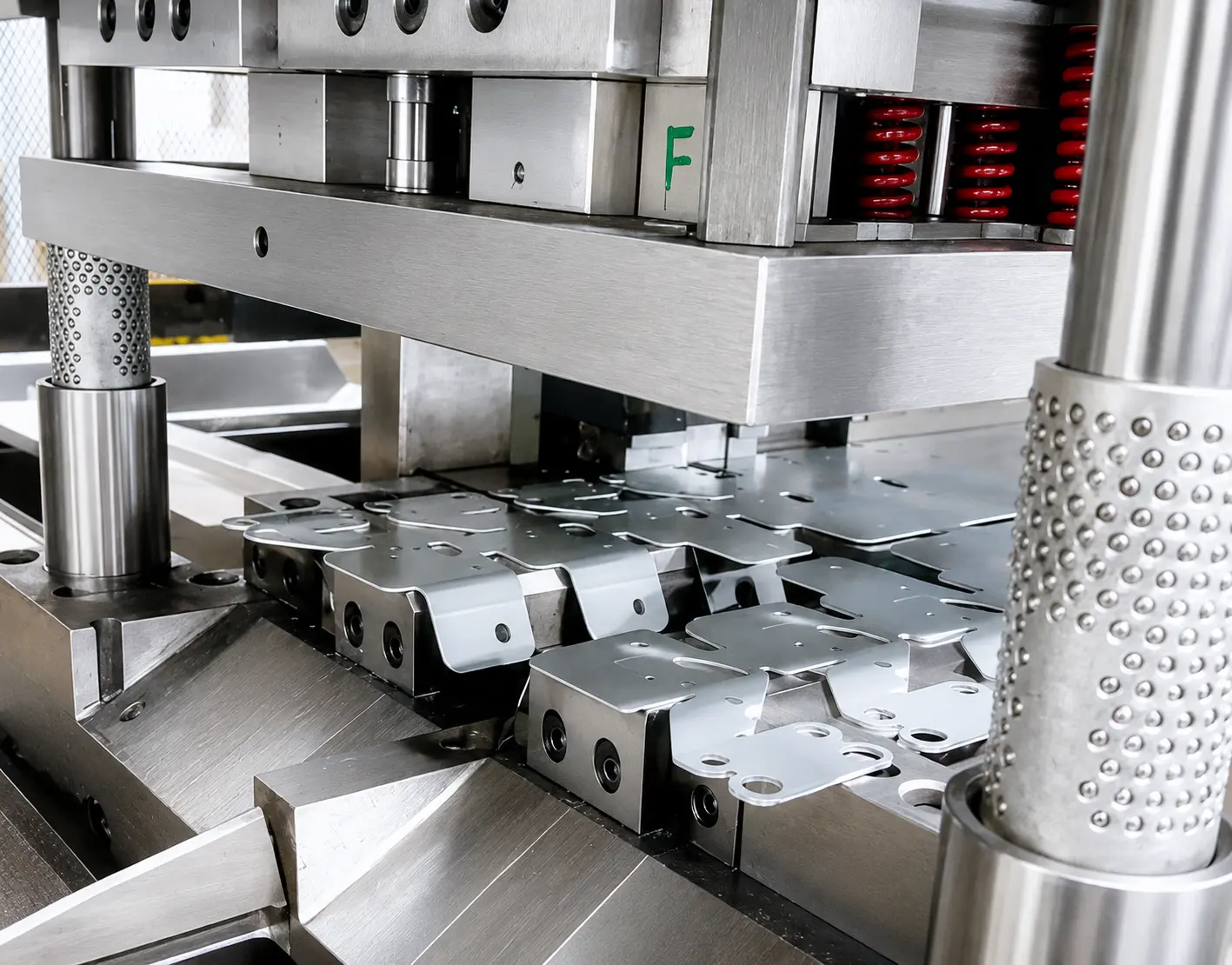
Progressive die stamping is a metal forming method. A metal strip moves through a line of stations inside one die set. Each station does one job, such as punching or bending. The last station cuts the finished part free.
The method is fast, and every part comes out the same. Dechen Metal Machining has made custom metal parts in Hebei, China since 2013. Every number below comes from its own published data.
This guide covers the die, the press steps, the metals, the real limits, and how to check a supplier.
Progressive Die Stamping, Defined Without the Jargon
Progressive die stamping is a one-tool process. A strip runs through many stations. Each station adds one feature to the part. Shop floors call it “prog die” stamping.
The carrier strip is the key idea. The part stays joined to the strip as it moves. The strip works like a conveyor. Each part lands in the same spot at every station, and nobody lifts it.
How the Strip Moves Through the Tool
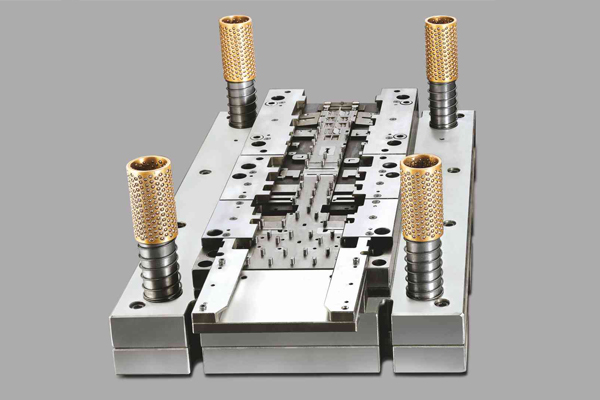
- Strip metal feeds into the progressive stamping press
- Each station performs one set function, such as bending or punching
- The part rides the carrier strip from station to station
- The last station cuts the part free
Inside Progressive Stamping Dies: What Each Station Does
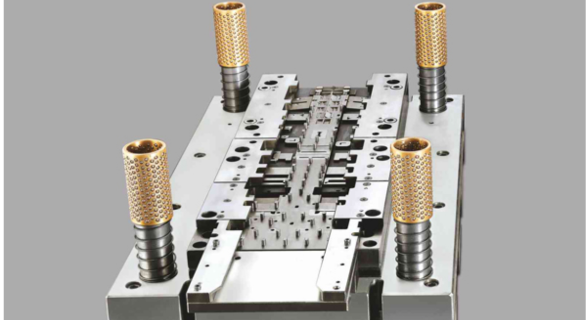
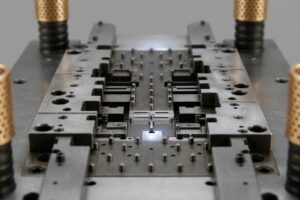
A progressive die is a tool block. It holds several work stations in a fixed order. Multi-stage stamping means one press stroke drives them all. The part gains a new feature at each step.
What a Single Station Does
Progressive stamping dies combine five published operations.
- Blanking – the metal cut out of the sheet becomes the part
- Punching – a die and punch cut the sheet. The extra material is removed. What is left is the part
- Bending – the sheet is bent around one axis into L, U or V shapes
- Drawing – force pushes sheet metal into a cavity or around a shape
- Embossing – a die presses a pattern onto the workpiece
Why Dies Are Cut From Tool Steel
Stamping dies are made from tool steel. It is hard enough to cut most other metals, and it holds your required tolerances. That hardness keeps hole size and bend angle steady deep into a run.
Why In-House Tooling Matters

Dechen designs its tools with CAD/CAM software. It makes precision dies and tooling in-house, in its own tool and die shop. So if a station needs a change, the tool never leaves the building.
The Progressive Stamping Process, Step by Step
The progressive stamping process runs in five stages. Steps 1 to 4 are general press mechanics. They apply to any progressive line.
- Strip feed. The strip enters the progressive stamping press. It moves forward one set pitch per stroke.
- Station operations. Each station makes its cut or form as the press closes.
- Carrier travel. The part stays on the strip and moves with it.
- Cutoff. The last station cuts the part free from the carrier.
- Secondary work and checks. Parts move on for extra processing and measurement.
Stage five is where suppliers differ. Dechen lists heat treatment, laser marking, laser welding, finishing, tumbling, anodizing, painting, passivation, and assembly and packaging.
Which Metal Stamping Method Fits Your Part?
Three things decide the method. Part depth, run size, and the number of forming steps.
| Method | How it works | Best suited for | Typical run size |
| Progressive die | Strip moves through a line of stations, each doing one function | Complex parts that must all come out the same | Medium to very large |
| Drawn stamping | A punch feeds blanks into a die | Very deep shapes, with low material waste | Low volume, simple parts |
| Transfer stamping | Automated systems move parts between tooling stations | Close-tolerance parts needing several forming steps | High volume |
Run size, part sameness and part complexity decide the winner. A deep cup in a short run often suits deep-drawn parts better than progressive die stamping.
Where Do Stamped Metal Parts End Up?
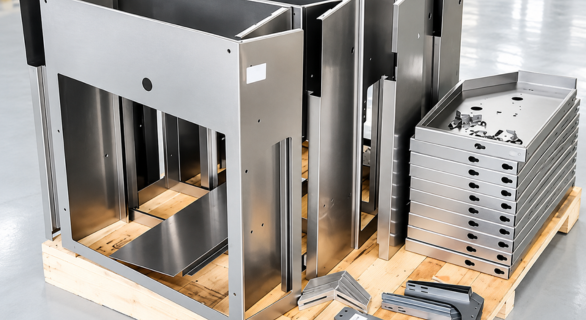
Stamped metal parts sit inside most products that use thin, formed metal. Below are the industries Dechen names for its custom metal stamping work.
- Hardware – brackets, clips and fasteners in long runs
- Automotive – repeatable automotive components where every unit must match
- Aerospace – light formed parts held to tight limits
- Medical – small stainless or titanium items with clean edges
- Electronics – thin contacts and shielding forms
- Electric power, home appliances, agriculture, and industrial manufacturing – formed structural parts at scale
Why Choose Progressive Die Stamping Over Single-Stage Tooling?
When you require the same part again, Progressive Tooling is superior. The use of a single or progressive die results in one-step forming, which minimizes the cycle time and enhances the output.
Complex Geometry Capability
The process generates parts with complex forms, holes, and bends. These are difficult to solve using normal approaches. Features that need three setups may be at three stations.
Cost Per Part Falls With Volume
Tooling is a one-time cost. Then the price per part falls a lot on huge batches. That’s why high-volume metal stamping and progressive tooling are a natural pair.
Surface Quality Ready for Finishing
The smooth surface allows the item to be used immediately. Or to straight to painting, plating or anodizing. Less cleaning means fewer marks on a completed face.
Which Metals Run Well in a Progressive Die?
Most soft, flexible sheet metals are amenable to progressive die stamping. A decent starting point is the published grade list below.
| Material | Published grades | Published characteristics |
| Aluminum | 1050, 1060, 1100, 3003, 5052, 5754, 6061, 6063, 6082, 7075 | Lightweight, excellent ductility |
| Stainless steel | 301, 304, 316/316L, 321, 410, 420, 430, 440, 17-4PH | Corrosion resistant, high strength |
| Cold rolled steel | 1005, 1006, 1008, 1010, 1017, 1018 | High strength, good formability |
| Copper and beryllium copper | C101, C110, C145, C172, C173, C360, C464 | High conductivity, suits micro-stamping and precision connectors |
| Titanium | – | High strength, lightweight, corrosion resistant |
| Nickel alloys and Inconel | – | High-temperature and corrosion resistance |
Other market-available materials can be supplied on request. The full stamping materials list carries every grade.
What Technical Limits Should You Design Around?
Check the limits before you finish the drawing. They decide if a part can be made at all. The ranges below apply to Dechen’s precision metal stamping work.
| Parameter | Range |
| Material thickness | 0.2 mm – 8 mm |
| Dimensional tolerance | ±0.05 mm |
| Maximum press force | 10 – 600 tons |
| Surface roughness Ra | 1.6 – 3.2 μm |
| Annual output | ≥ 500,000 pcs |
| Tooling life | 300,000 – 1,000,000 cycles+ |
Two points matter in precision metal stamping. Parts as thin as 0.005 inches are possible, with tolerances that often exceed industry standards. And the ±0.05 mm figure holds in mass production, not just on a first sample.
What Happens After the Part Leaves the Press?
Surface treatment comes after the press. The base metal drives the choice. Published options are: as machined, sand blasting, anodized, alodine, powder coating, polishing, electroplating, wire drawing, knurling, painting, laser marking, screen printing and passivation.
Match the treatment to the metal, not to the look. Anodizing and alodine suit aluminum. Passivation suits stainless steel, steel and brass. Powder coating and painting work on all metals. The same rules guide sheet metal fabrication work.
What to Confirm Before Choosing a Metal Stamping Manufacturer
Ask for proof, not praise. This checklist tells a real tool room from a broker.
- In-house tool and die work, not outsourced tooling
- Published tolerance and thickness ranges you can check against your drawing
- A quality system covering incoming material, in-process patrol inspection and finished product delivery
- Documented quality certifications you can ask to see
- Material traceability and NDA handling
- Prototyping capacity next to mass production
Cangzhou Dechen Metal Products Co., Ltd. was founded in 2013, in Hebei Province, China. The plant covers over 10,000 square meters, with more than 80 sets of precision production equipment. Send 2D drawings or 3D CAD models to its custom metal stamping services page. A quote comes back within 24 hours.
Frequently Asked Questions
What is progressive die stamping used for?
Progressive die stamping is used to make high volumes of small and medium metal parts that must all match. It fits hardware, automotive, aerospace, medical and electronics work. Parts with several cuts or bends suit it best, because each feature gets its own station.
What is the difference between progressive and transfer stamping?
The difference is how the part travels. In a progressive tool, the part stays joined to a carrier strip. In transfer stamping, automated systems move loose parts between tooling stations. That allows deeper forms and more forming steps.
How tight are the tolerances in a progressive die?
Dimensional tolerance is held within ±0.05 mm, and that figure holds in mass production. Surface roughness Ra runs from 1.6 to 3.2 μm.
- Check your critical dimension against ±0.05 mm before design freeze
- Ask if the number is a sample figure or a production figure
What thickness of metal can be stamped?
Material thickness runs from 0.2 mm to 8 mm. Parts as thin as 0.005 inches are also possible.
- Thin gauges suit contacts, shims and shielding
- Thick gauges suit brackets and structural parts
Is progressive tooling cost effective for small runs?
No, not usually. Tooling is a one-time cost, so the price per part only drops in high-volume metal stamping. For short runs of simple parts, drawn stamping is often better, and it wastes less material.
How long does a progressive die last?
Tooling life runs from 300,000 to 1,000,000 cycles or more. Real life depends on material hardness, part shape and upkeep.
- Harder materials cut die life short
- Planned upkeep adds usable cycles
Which materials suit multi-stage stamping?
Aluminum, stainless steel, cold-rolled steel, copper, beryllium copper, titanium, and nickel alloys such as Inconel all work. Grade choice depends on strength, conductivity, and corrosion needs.
Conclusion
Progressive die stamping fits parts that are complex, thin, and needed in big numbers. The tooling cost is paid back across the run. When depth matters more than volume, drawn or transfer methods are the better call.
Dechen Metal Machining is worth a look for one reason: it publishes its limits. The ±0.05 mm tolerance, 0.2–8 mm thickness, and 10–600 ton press force are stated openly. Its in-house tool and die shop keeps fixes under one roof. As a metal stamping manufacturer, it works straight from your drawings, so send one to request a quote.