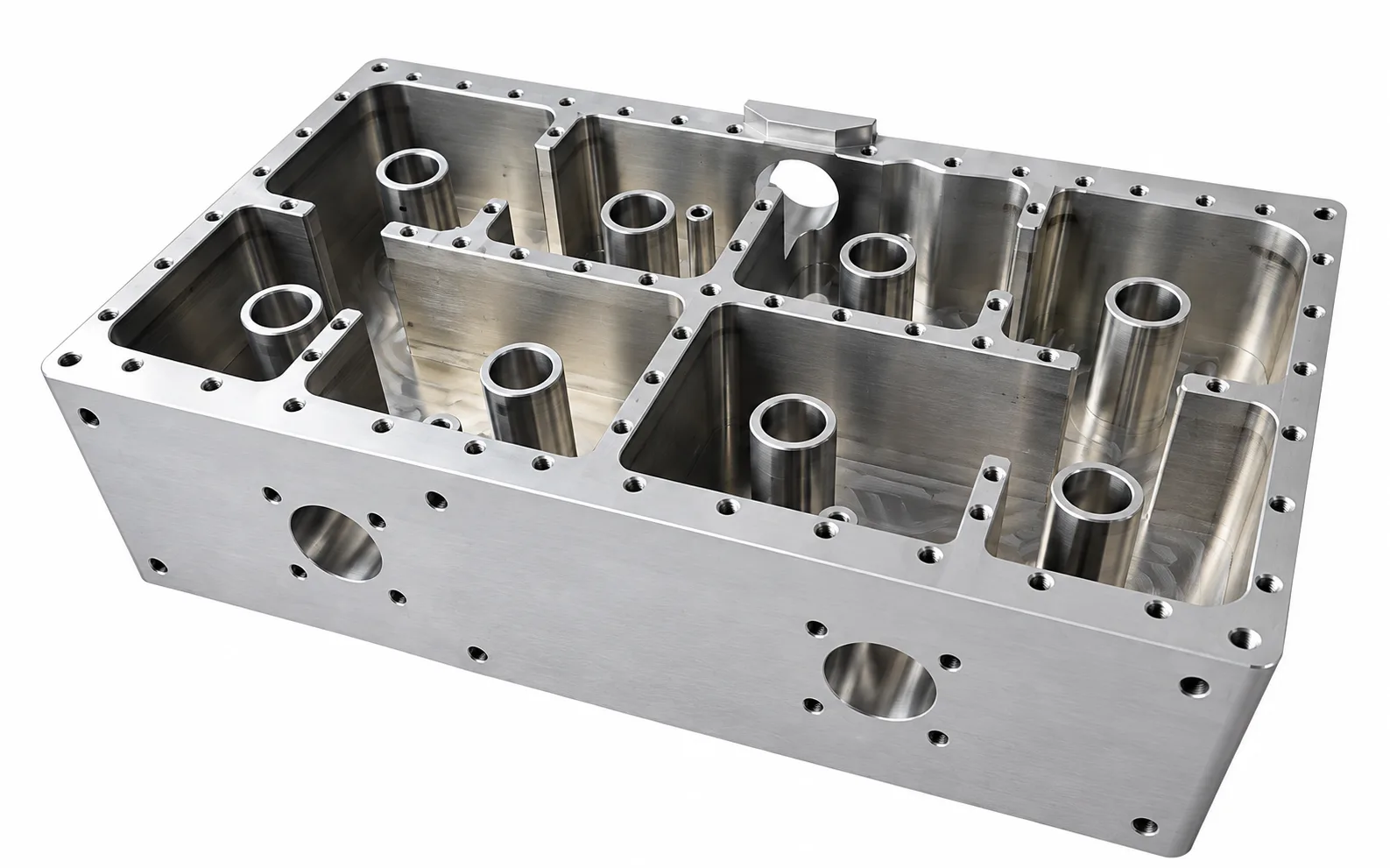
One drawing goes out to three shops. The part has features on five faces. Three quotes come back with three different dates. Most buyers read that gap as a price gap. It is usually a setup gap. Across CNC Machining Services China suppliers, one thing drives cost, timing, and accuracy. It is the number of times the part is clamped, cut, released, and clamped again. Machinists with 30 to 40 years on CNC equipment count setups first. This article covers what a setup is. It shows how five-axis work removes them. It also explains the two tolerance numbers.
Setups drop when one machine reaches several faces at once. Simultaneous 5-axis CNC machining works multiple surfaces and angles in a single operation. Fewer clamps mean fewer chances for error. They also give tighter dimensional control and a shorter path from raw stock to finished part.
What Is a Setup in CNC Machining?
A setup is one clamping of a part on the machine. One setup means the part is clamped once, zeroed once, and cut once. A three-setup part is clamped, cut, and released. Then it is turned, clamped again, zeroed again, and cut again.
Each round adds idle time. Each round also adds a chance for the part to sit a little off true. The setup count is a hidden cost inside precision machining services. It rarely shows in a quote. It still moves the price.
Setup Count Against Handling Risk
| Setups | Handling steps | Re-zero events | Main risk carried |
| 1 | Clamped once | 0 | Fixture must reach every cut face |
| 2 | Clamp, release, re-clamp | 1 | Small position shift between two faces |
| 3 | Two releases, two re-clamps | 2 | Small shifts begin to stack |
| 4 or more | Repeated handling | 3 or more | Feature-to-feature alignment drifts |
Where Does Five-Axis Work Remove the Handoff?
Five-axis work simultaneously moves the tool and the part along five axes. Angled features may be accessed when the part is clamped. So the face-to-face hand-off disappears. Dechen refers to this as multiple surface and angle machining in one operation on its own capability site. Dechen also does 3-axis and 4-axis milling and turning. The part chooses the machine.
Angled Holes, Undercuts, and Compound Faces
The most obvious example is an angled hole. A fixture that tilts the part is required for a 3-axis machine hole at 30 degrees. That fixture is another arrangement. 5-axis CNC machining – The head finds the angle itself.
When Three Axes Are Still the Right Call
For flat parts with features on 1 or 2 faces, three axs remain right. The program is easier. Often the cycle time is cut. The extra axs on a basic part are an expense, not an accuracy. This call is made at the consult stage with free DFM review.
Why Does Stack-Up Error Show Up at Assembly?
The stack-up error is the accumulated tiny position changes left by each re-clamp. One shift is nothing. Three in a row may pull a hole pattern out of a hole with a machined boss.
Such a part often passes inspection. Every single dimension continues to be contained inside its band. Up at the assembly, the problem appears. Less preparation for the straight repair. This is why multi-axis routeing promotes tight tolerance machining, not simply quicker cutting. Dechen inspects incoming material, patrols work in progress, and inspects the final product for dimensions, tolerances, appearance, and performance.
How Should the Two Tolerance Numbers Be Read?
Machine accuracy and part tolerance are two separate metrics. Dechen lists both. Never combine them together.
CNC equipment is calibrated to an accuracy of ±0.0001 inch. Part size and tolerance is controlled from ±0.01 mm to ±0.1 mm per requirement.
The first number is what the machine has under defined circumstances. The second is what your feature is acknowledged to be. Band movement is caused by material, wall thickness, and finishing. If a business says they can hold a certain tolerance as a commitment for all parts, they are selling machine accuracy.
Two Numbers That Are Often Confused
| Figure | What it describes | Stated value | How a buyer should use it |
| Machine accuracy | Calibrated accuracy of the CNC equipment | Within ±0.0001 inches | Read it as a machine tool capability |
| Part tolerance | Controlled size and tolerance on the finished feature | ±0.01mm to ±0.1mm per demand | Agree it per feature during review |
What Do CNC Machining Services China Cover In-House?
In-house capabilities include 5-axis simultaneous machining, wire EDM, lathe turning, milling, and precision deburring. Thus, the cell has more than one milling head. The plant spreads over more than 10,000 square meters. It has more than 80 sets of precision production equipment.
Each travel to an outside vendor is an extra handling step. Wire EDM services are a good choice for a one-time work. Wire EDM cuts shapes that a spinning tool cannot reach. Consider sharp corners and narrow slots in hard metal. It is located adjacent to CNC milling and turning services keeping the part all inside one building.
Who Decides the Machining Angles?
A five axis programme is a planning job, not a cutting one. The face order is given by someone who examines the drawing, picks the datum, and builds the fixture.
Dechen’s team has machinists with 30-40 years of CNC expertise. They are supported up by a succession team with more than 20 years of expertise. Nanpi County, Cangzhou City, Hebei Province, China, is where the plant is located. For a precision CNC machining manufacturer, the working part of experience is a mix of senior and mid-career professionals.
How Does Material Change the Setup Plan?
Metals respond differently when the clamp is released. So the material alters the setup schedule. Aluminium may relieve built up tension and spring a bit. Nickel and titanium alloys are good for shape retention but need a stronger push from the tool. Heat resistant grades provide you fewer re-clamps. The starting point for a custom metal machining plan is the grade, not the shape.
Metals Cut and Formed In-House
- Aluminum, including 5052, 6061, and 7075
- Stainless steel, including 304 and 316
- Titanium, used for medical and automotive work
- Copper and beryllium copper
- Cold-rolled steel
- Inconel, nickel alloys, Monel, Haynes, and Waspaloy
- Brass and bronze
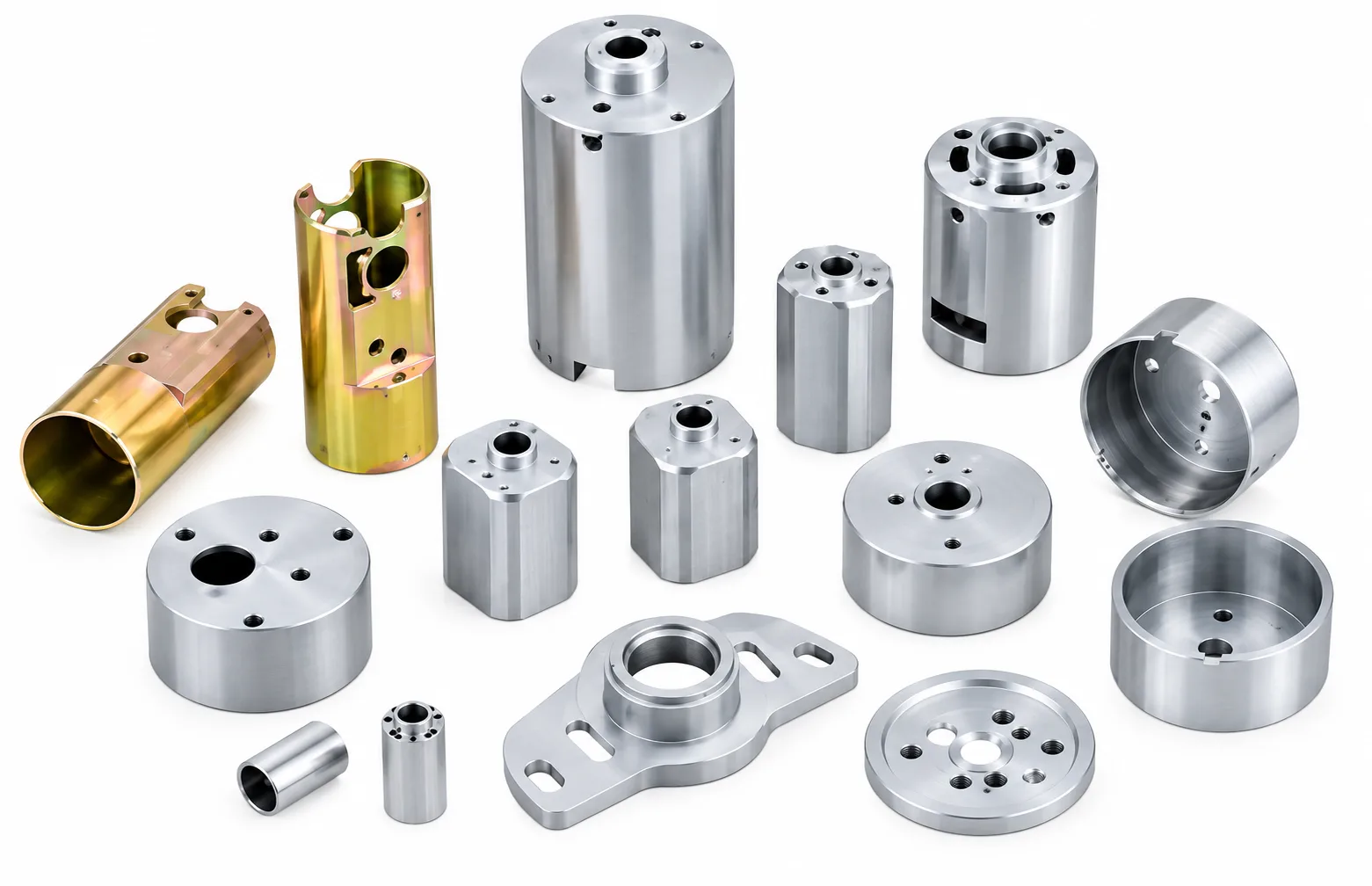
Custom CNC machined parts in these grades serve the automotive, medical, electronics, and energy sectors.
What happens between the CAD File and the binding quote?
The intake path is short and published. Six steps cover it.
- Send 2D drawings or 3D CAD models in.STEP,.IGS or DWG.
- Engineering reviews the specs, material needs, and tolerances.
- A detailed, binding quotation will be returned within 24 hours.
- Free DFM feedback flags features that force extra setups.
- Samples are made and checked for size and quality.
- Batch production follows, then full QC and delivery.
NDA confidentiality and material traceability apply throughout. Prototype, small batch, and mass production are all supported. So a drawing needs no second supplier when volume grows.
Where Is Lead Time Actually Won?
Lead time is won before the first chip is cut. Four things move it: setup count, DFM feedback before programming, a quote inside 24 hours, and finishing done in-house.
A day range for machined parts would be a guess. Most CNC Machining Services China listings post one anyway. Shape, material, and volume each shift the date. A real date comes from an engineering review of the drawing. That is why a 24-hour quote window beats any posted range.
What Should Be in the Brief Before Files Are Sent?
A full brief removes one round of questions.
Six Items to Confirm Before Sending Files
- File format, sent as.STEP,.IGS or DWG
- Critical dimensions are marked clearly on the drawing
- Tolerance band stated per feature, not per part
- Material grade is named, not just the metal family
- Surface finish needed, including any post-process
- Quantity for the first order and the repeat schedule
Frequently Asked Questions
-
What does 5-axis CNC machining change for a complex part?
In a single operation, five-axis machining cuts many surfaces and angles. The part remains clamped. Then features on diverse faces have one reference. This is the primary lever for cutting handling on multi-face work among CNC machining services China.
-
How accurate is Dechen’s CNC equipment?
Dechen’s CNC machines are calibrated to within ±0.0001 inches. That number is the machine tool. It does not guarantee tolerance on every feature.
-
What part of tolerance can be controlled?
Part size and tolerance are controlled from ±0.01 mm to ±0.1 mm per requirement. The precise band is decided upon during the engineering review. Material and form both influence what holds.
-
How fast does a quotation come back?
Detailed, binding quote within 24 hours. You get entire files and requirements to start the clock.
-
Does the plant handle prototypes as well as production runs?
Yes. Prototyping, small batch, and bulk production are all supported. Samples are examined for size and quality before batch production begins.
-
Is wire EDM available alongside milling and turning?
Yes. Wire EDM is housed in the same factory as CNC milling, lathe turning and deburring. Hard-to-access features remain on one site.
Conclusion
Set up the count, ties, price, timing, and fit together. The two tolerance numbers should be read separately, not as one. If a provider is accurate or merely noisy, that’s all you need to know.
Among the CNC Machining Services China Five-Face Part Shortlists, Dechen Metal Machining Is Worth a Quote. In one facility, there is five-axis work, wire EDM, and turning. Not integrated into a single claim, the two tolerance figures remain distinct. Send the drawing to the customization page and get a binding quotation within 24 hours.